
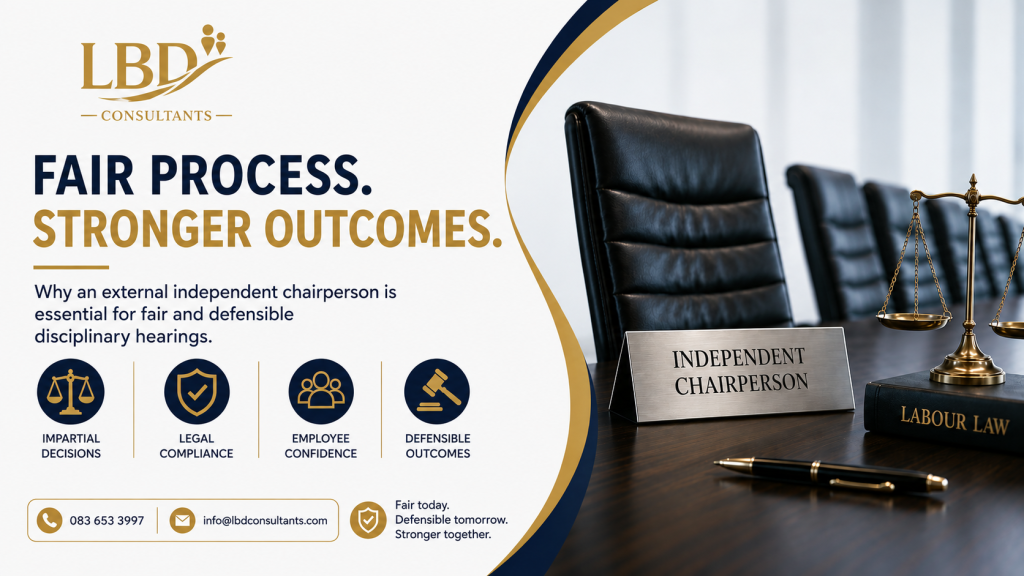
Independent Chairperson for Disciplinary Hearings: Why It Matters
In South African labour law, the fairness of a disciplinary process is a legal requirement, not a box-ticking formality, and it can determine whether a dismissal stands or falls. The Labour Relations Act (LRA) and the Code of Good Practice: Dismissal in Schedule 8 both require employers to follow a fair procedure before ending employment. An independent chairperson for disciplinary hearings sits at the centre of that requirement. Consequently, employers who appoint an external, unconnected chair protect the impartiality, legal compliance, and ultimate legitimacy of every disciplinary outcome. This article, from LBD Consultants’ Labour Law Division, sets out why that appointment matters and what to look for when arranging one.
What an Independent Chairperson for Disciplinary Hearings Does
An independent chairperson for disciplinary hearings removes the real or perceived bias that almost always exists when an internal manager presides over a case. Internal chairs frequently have a prior working relationship with the accused employee or the complainant, and may feel pressure, subtle or direct, from senior management to reach a particular outcome. Section 188 of the LRA requires a genuinely fair hearing, and any hint of bias undermines that requirement regardless of how strong the substantive case against the employee is. An external chair, with no reporting line to either party, brings the objectivity the law demands and protects the hearing’s integrity from the outset.
Procedural Fairness Under South African Labour Law
Procedural fairness under the LRA and the Code of Good Practice covers far more than simply holding a hearing. It requires proper notice of the charges, a genuine opportunity to respond, the right to representation, and a decision-maker who has not prejudged the outcome. Therefore, even a dismissal with overwhelming substantive grounds can still be overturned if the process itself was flawed. Employers in the IT and engineering sectors, where scarce technical skills make every dismissal dispute costly, are particularly exposed here, as are training companies and skills development providers managing disciplinary matters across project-based facilitator teams. An independent chair reduces this exposure by keeping the hearing itself beyond reproach.
Reducing CCMA Unfair Dismissal Risk
External chairpersons typically bring specialised labour law knowledge that an internal manager rarely has, which directly lowers CCMA unfair dismissal risk. Many practising attorneys and experienced labour practitioners who chair hearings understand the onus of proof, the correct procedural sequence, and the distinction between substantive and procedural fairness, three areas where internally chaired hearings commonly go wrong. As a result, hearings run in line with the Code of Good Practice are far less likely to end in a costly reinstatement or compensation order at the CCMA. Given how rigorously the CCMA scrutinises disciplinary records, this expertise is not a nice-to-have; it is the difference between a defensible dismissal and an expensive one.
Choosing Disciplinary Hearing Chairperson Services
- Genuine independence: the chairperson should have no reporting line, personal relationship, or prior involvement with either party to the dispute.
- Labour law expertise: look for a practising attorney or CCMA-accredited case handler who understands onus of proof and the substantive versus procedural fairness distinction.
- Sector familiarity: experience with technical and project-based workforces helps when the dispute involves scarce-skills employees or short-term facilitator contracts.
- Clear scope and record-keeping: the chairperson should produce a properly documented outcome and reasoning that can withstand CCMA scrutiny if referred.
How LBD Consultants Supports Workplace Disciplinary Process Compliance
Appointing an independent chairperson for disciplinary hearings is not an unnecessary cost; it is a strategic safeguard for workplace disciplinary process compliance. LBD Consultants’ Labour Law Division, led by an Advocate and supported by CCMA-accredited case handlers, chairs and appeals disciplinary hearings for employers who need a genuinely independent outcome. Consequently, IT, engineering, skills development, and training-sector employers gain a defensible process, reduced CCMA exposure, and an outcome that employees are far more likely to accept without escalating into a broader dispute. Contact LBD Consultants today to arrange an independent chairperson for your next disciplinary hearing.