
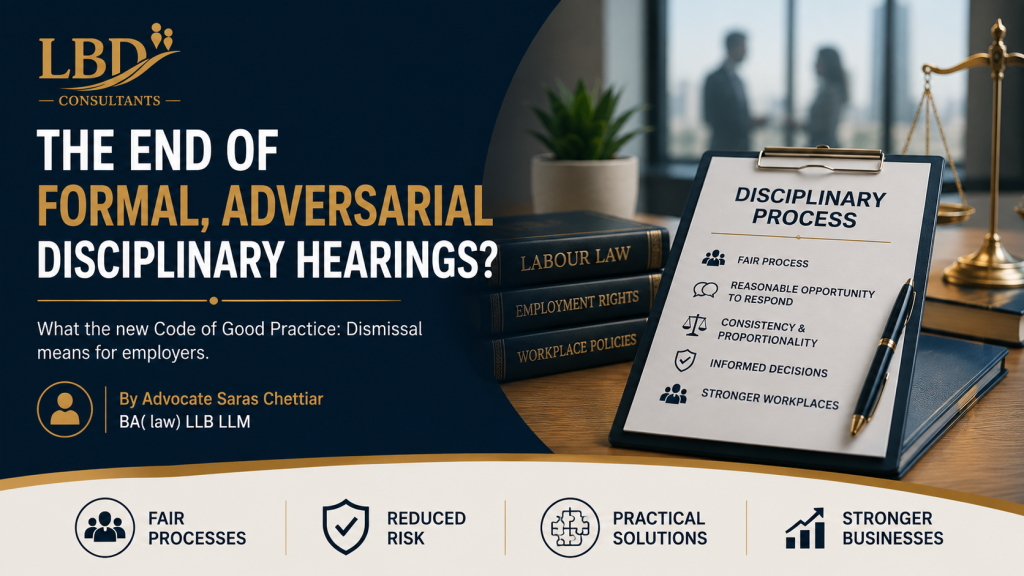
New Code of Good Practice Dismissal Rules Explained
For close to three decades, the words disciplinary hearing meant, in practice, a courtroom-style process: notice of charges, an independent chairperson, cross-examination of witnesses, and a paper trail thick enough to survive a CCMA challenge years later. For a ten-person IT consultancy or a small training provider without an in-house HR or legal team, this was rarely proportionate to the offence, yet it remained the safest way to avoid an unfair dismissal finding. That era is closing. The Code of Good Practice Dismissal in South Africa, which came into effect on 4 September 2025 and replaced the long-standing Schedule 8 of the Labour Relations Act, has shifted the legal architecture underpinning workplace discipline in a genuinely material way, and smaller employers in particular should be adjusting their practices now.
What the Code of Good Practice Dismissal in South Africa Requires Now
Schedule 8 never technically required a formal, quasi-judicial hearing either, but years of CCMA and Labour Court jurisprudence calcified the fair procedure requirement into a de facto standard: notice of charges, a hearing before an independent chairperson, the right to representation, the right to call and cross-examine witnesses, a considered written finding, and a right of appeal. Small businesses without HR departments were, in effect, held to the same procedural bar as large corporates. The new Code deliberately steps back from prescribing a formal hearing at all. Instead, the touchstone is that the employee must be given a reasonable opportunity to respond to allegations, reflecting the principle that procedural fairness need not be modelled on an adversarial trial, but rather on genuine dialogue. That is a different starting point in law, not merely in tone.
Reasonable Opportunity to Respond: What’s Changed and What Hasn’t
- No mandatory formal hearing: the employee must be notified of the allegations and given an opportunity to prepare and make representations on both the allegations and the appropriate sanction, without the trial-style choreography of the past.
- Representation and language rights remain: employees should, where possible, be permitted representation by a trade union representative or co-employee, and proceedings should be conducted in a language the employee understands. These protections have simply been detached from the requirement of a formal hearing.
- Inconsistency is no longer automatically fatal: inconsistent application of disciplinary rules does not automatically render a dismissal unfair where the nature of the misconduct makes continued employment intolerable, a meaningful recalibration from the old regime.
- Deviation is permitted, but must be justified: informality is allowed in exceptional cases, but the employer carries the burden of showing that the process it followed was fair in the circumstances.
Small Business Disciplinary Process South Africa: The SME Carve-Out
Perhaps the most consequential line in the new Code for smaller employers is its explicit recognition that small businesses may not have the resources to run formal processes, and that an informal hearing may suffice provided fairness is maintained. This is the first time proportionality has been built directly into the fairness enquiry based on the size and capacity of the employer, which matters enormously for LBD Consultants’ smaller training providers, skills development providers, and IT-sector clients running lean without a dedicated HR function. That said, the Code makes no mention of a formal disciplinary hearing at all, even though the CCMA has historically treated a hearing as an important indicator of procedural fairness. Employers should read that silence as a caution rather than an invitation to abandon structure altogether, since commissioners steeped in almost thirty years of practice under the old Code will not unlearn their instincts overnight.
Disciplinary Hearing Documentation Requirements That Still Apply
Even a properly run informal process needs a minimum architecture behind it. Allegations should be put in writing, however briefly, giving the employee genuine time to consider them rather than an ambush conversation in the passage. A sit-down conversation, where the employee can explain their side, ask questions, and raise mitigating factors, satisfies the reasonable opportunity to respond standard without needing a chairperson or sworn witness testimony. A representative should be allowed if requested, proceedings should be conducted in a language the employee understands and confirmed as understood, and a written record should capture what was put to the employee, what they said in response, and what was decided and why, since this record is what carries weight if a dismissal is later challenged at the CCMA. Importantly, none of this changes the substantive test of whether a dismissal was fair on the facts, and serious or complex misconduct, dishonesty, harassment, disputed cases, or matters involving senior employees, still warrant the fuller, more structured process, including an independent chairperson, that protects an employer’s evidentiary position later.
How LBD Consultants Supports Fair Dismissal Compliance South Africa
Employers should also watch the horizon. A draft Labour Law Amendment Bill, published for public comment in Government Gazette No. 54220 on 26 February 2026, proposes a dedicated, simplified small-employer dismissal code alongside a six-month probation cap, an earnings threshold for reinstatement claims, and increased retrenchment protections. The comment period has closed and the Bill is not yet law, but it signals that the direction of travel, simplification, proportionality, and explicit small-business carve-outs, is set to continue. LBD Consultants’ Labour Law Division helps training providers, skills development providers, and IT and engineering employers build the right-sized disciplinary process for each situation: lean and well-documented for straightforward misconduct, and fully structured, including an independent chairperson, for serious or disputed matters. Contact LBD Consultants today to review your disciplinary policy against the new Code.